
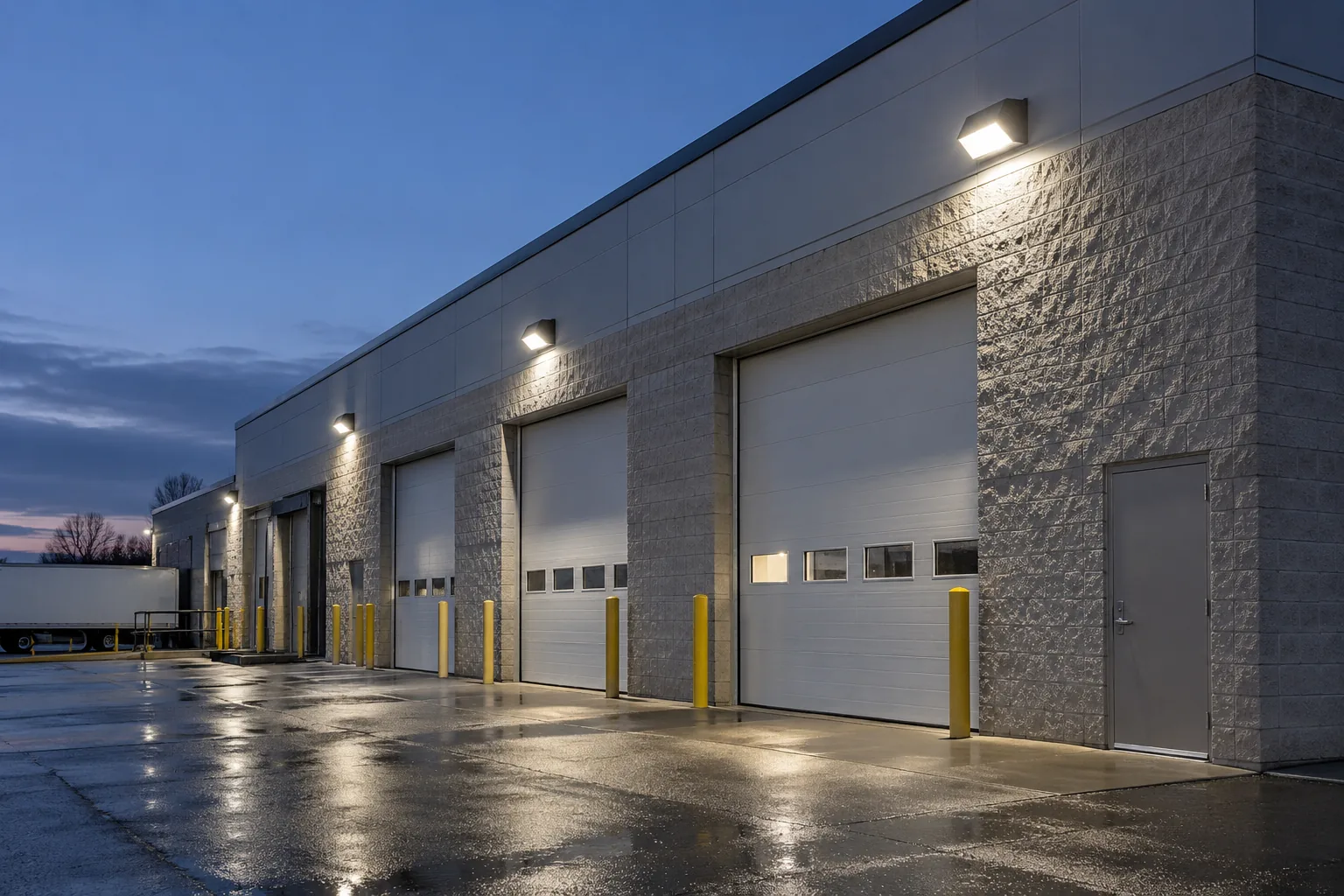
Understand the job each wall pack is doing
Start by identifying the area served by each fixture. A unit beside a loading door may need to support movement around vehicles; a fixture on a narrow side passage may mainly illuminate a walking route. Another may spill light into a parking aisle from a wall too far away to provide useful coverage. These situations should not receive one automatic replacement specification.
Map the relationship between the wall, door openings, parking spaces, fences and property boundaries. Projecting canopies and equipment can obstruct light, while bright adjacent fixtures may disguise a gap in the building’s own coverage. A night-time observation from the walking route and neighbouring edge is often more informative than looking at the fixture in daylight.
For commercial properties in Dixie, Meadowvale and other Mississauga employment areas, practical concerns often include deliveries, employee entrances and side-yard access. Describe the actual use rather than classifying the entire perimeter as one security zone. This makes it easier to decide which existing positions should be retained and where the wider lighting arrangement needs review.
Diagnose an outage before selecting a replacement
A failed wall pack may have a fixture-specific problem or may be responding to a fault elsewhere. If several units fail together, the shared circuit or control arrangement deserves attention. If a single fixture is dim, flickering or intermittent, record that behaviour and whether it changes with weather or operating time.
Look for patterns from the ground: all lights starting late, one fixture staying on during the day, repeated failures after rainfall or a unit that operates only occasionally. These observations help define the service request. They do not require anyone to open the fixture or attempt an electrical repair.
Where replacement parts are available and the housing remains suitable, repair may be worth considering. A deteriorated enclosure, poor distribution or repeated failures may support replacement instead. The commercial lighting repair pathway separates investigation from the choice to upgrade, so a straightforward outage does not become an unexplained whole-building replacement recommendation.
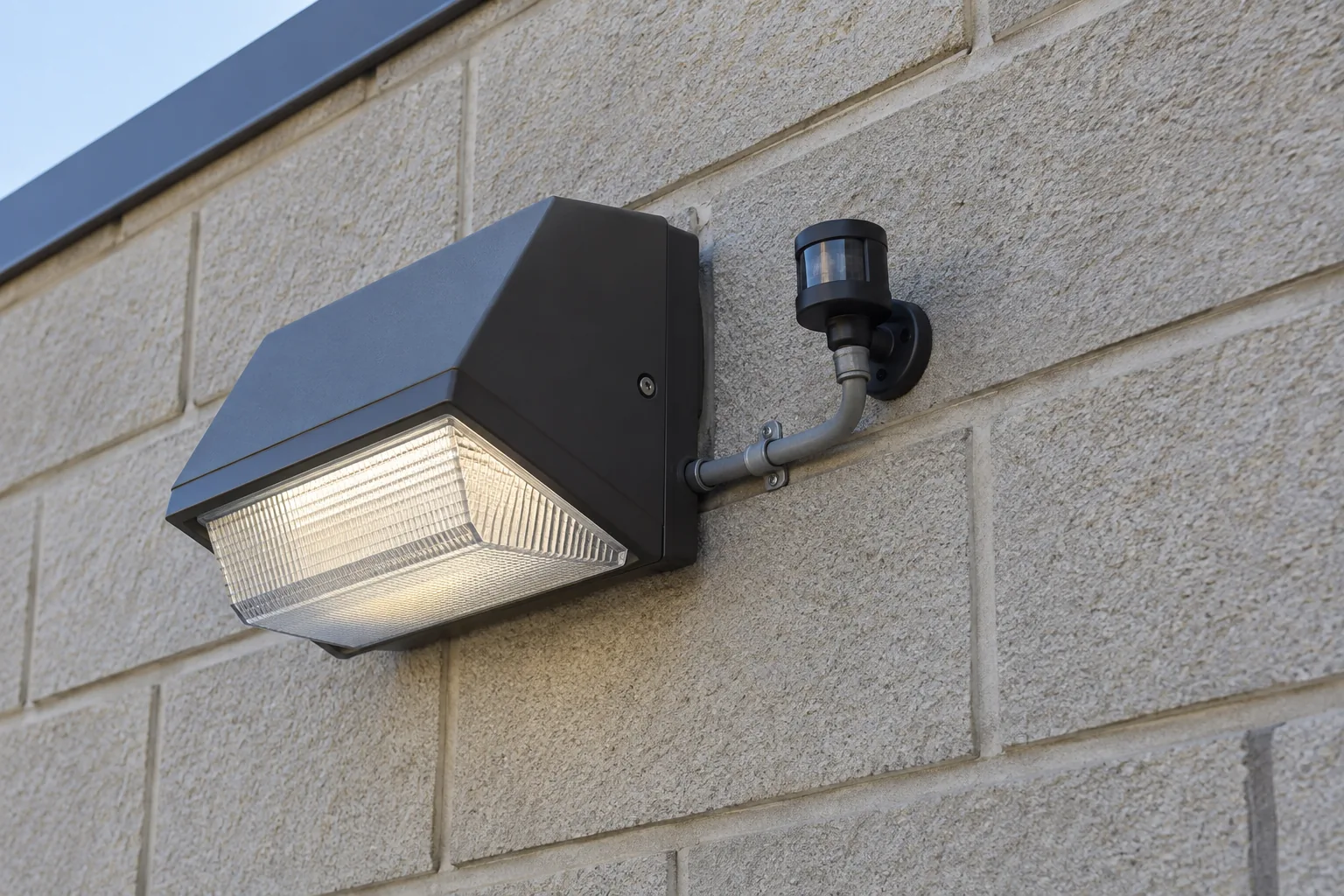
Control glare before adding output
Traditional wall packs can send light outward as well as toward the intended surface. On a boundary wall, this can be especially noticeable from neighbouring windows or a driver’s approach. The relevant question is not whether the fixture looks powerful, but whether it places useful light where the property needs it.
Shielded or more controlled distributions may suit some locations, but the product still needs to be assessed at the proposed mounting height and distance from the target area. A fixture mounted too low can remain visually intrusive even with a more controlled optic. A unit mounted too high may miss a narrow route or create excessive contrast beneath projecting features.
Review light spill and direct views of the source from surrounding properties. Fixture orientation, shielding and position should be part of the selection process. If more reach is needed across a large yard, another fixture type or location may be more appropriate than forcing a wall pack to cover the entire area. Coordinate the decision with commercial exterior lighting planning.
The City’s Nuisance Lighting By-law specifically addresses wall-pack emissions that create noncompliant glare or light trespass. Replacing an older fitting is an opportunity to review its direction and shielding, particularly along boundaries; matching the old wattage does not address those concerns.
Check the mounting surface and exterior conditions
Replacing a wall pack involves more than matching a footprint. Existing mounting positions may be on metal cladding, masonry or another wall assembly with different access and sealing considerations. Record evidence of damage, loose mounting, water staining or previous patching so the scope can identify conditions requiring attention.
Fixture suitability should reflect exposure to weather, local moisture conditions, temperature and the way the area is used. A service yard may introduce dirt or impact risks that are absent at a sheltered office entrance. Product ratings and mounting instructions matter; a similar-looking enclosure is not enough to establish suitability.
Coordinate any building-envelope concerns with the appropriate trade. Lighting work should not be presented as a cure for unrelated leaks or damaged cladding. Access also needs planning where landscaping, stored material, parked vehicles or equipment block the wall. A replacement request should identify these restrictions before equipment and labour are scheduled.
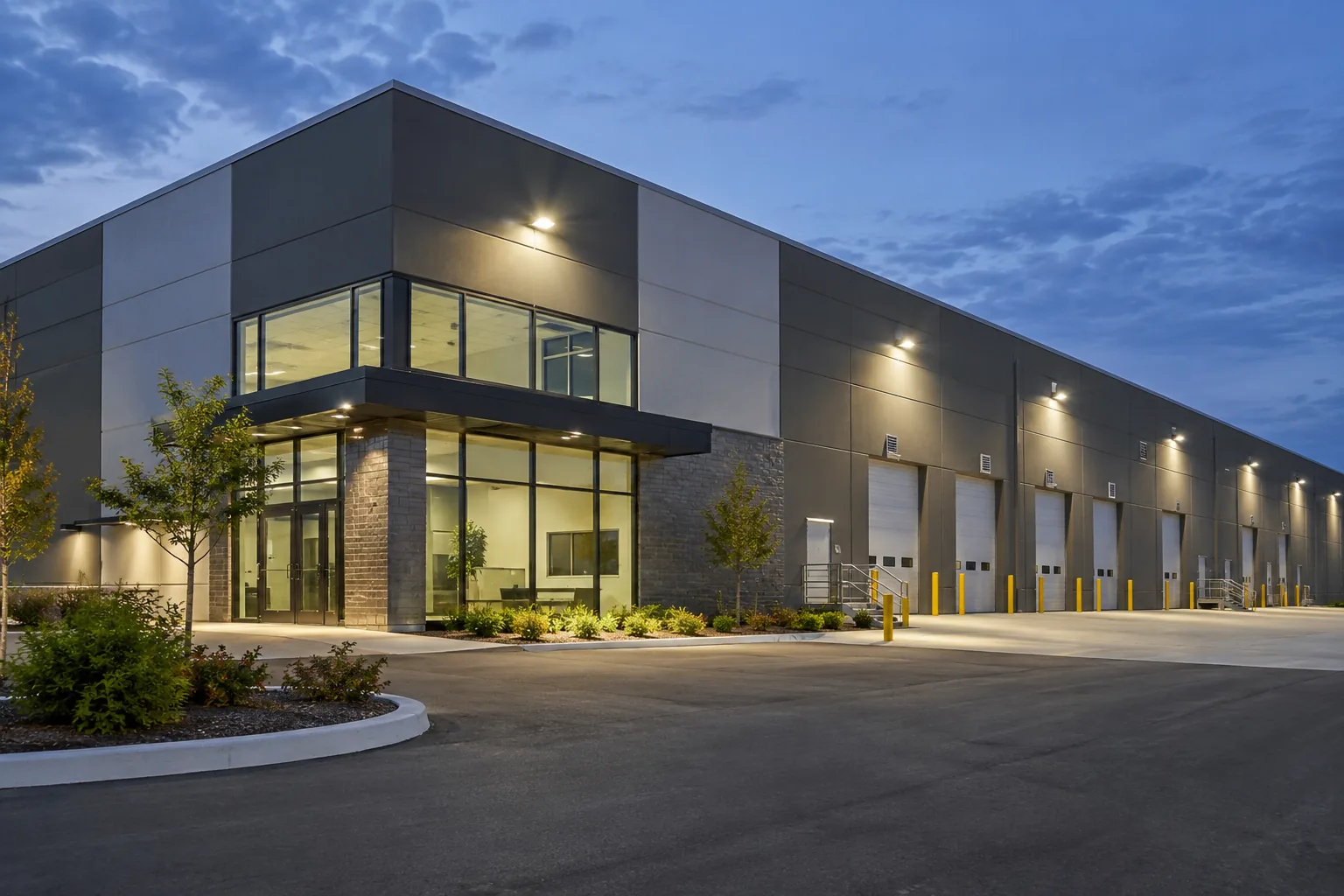
Connect the fixture to a clear operating strategy
Some wall packs have individual photocells, while others respond to a shared timer, contactor or building control. Establish the current arrangement before changing equipment. Adding fixtures with their own controls to an already controlled circuit can create behaviour that building staff find difficult to interpret.
Consider whether all façades require the same schedule. A public entrance may remain active after office hours while a service area is used at different times. Where scheduling or reduced-output functions are proposed, explain the desired response and review equipment compatibility rather than assuming every LED fixture will dim correctly.
Photocells also need suitable placement relative to natural light and nearby illumination. A control that sees reflected fixture light may behave differently from one with a clearer view of ambient conditions. Problems such as daytime operation or late evening start-up belong within photocell and exterior lighting controls assessment, especially when the fixture itself still operates.
Keep entrances and pedestrian routes visually coherent
Building-mounted lighting often overlaps with door lights, canopy fixtures and walkway lighting. Review those systems together where people move from one zone to another. A harsh wall pack beside a softly lit entrance can create uncomfortable contrast, while a bright doorway can make an unlit side route feel even darker.
Colour consistency matters when several fixtures are visible at once. It does not mean that every exterior application must use an identical product, but adjacent replacements should be selected deliberately. Product output, optical pattern and colour appearance should be considered together, particularly when only part of a façade is being renewed.
At entrances, pay attention to door hardware, changes in level and the approach from parking. At side passages, consider obstructions and the direction of travel. Entrance and walkway lighting planning can identify when a wall pack is serving the route well and when another approach would better support the space.

Scope the work and prepare useful information
For service, provide the property address, affected wall or doorway, fixture quantity and a description of the fault. Photographs should show the complete mounting location and the surrounding area, not only the illuminated lens. Include approximate mounting height if known and explain any restrictions on access beside the building.
For a replacement programme, identify whether the objective is fewer failures, better coverage, improved control behaviour or reduced glare. Record existing equipment where labels can be accessed safely by qualified personnel. Where multiple buildings are involved, a consistent inventory makes it easier to select a practical range of replacement products and spares.
A clear scope should distinguish fixture replacement, control changes, electrical investigation and any repairs to the mounting surface. If the existing location is unsuitable, ask for that issue to be identified before equipment is ordered. The most useful result is a dependable exterior arrangement that can be understood and maintained, with each fixture selected for its actual role.
Questions facility managers ask
Can an LED wall pack replace an older HID fixture?
Often a replacement can be considered, but selection requires more than matching wattage. Review supply compatibility, mounting, coverage, glare and the operating controls. The proposed LED distribution may differ substantially from the older fixture, so the affected area should be considered as part of the decision.
Why is one wall pack on during the day?
A photocell, timer setting, override or other control condition may be involved. Some faults occur at a single fixture while others affect a group. Record which lights behave differently and when. A qualified assessment can separate a control issue from a problem within the fixture.
Will replacing wall packs fix a dark parking area?
It depends on the distance and geometry. Building-mounted fixtures may not provide appropriate coverage across a wide lot. Increasing output can add glare without addressing the dark area. Review the relationship between wall packs, pole lights and pedestrian routes before deciding on the replacement approach.