
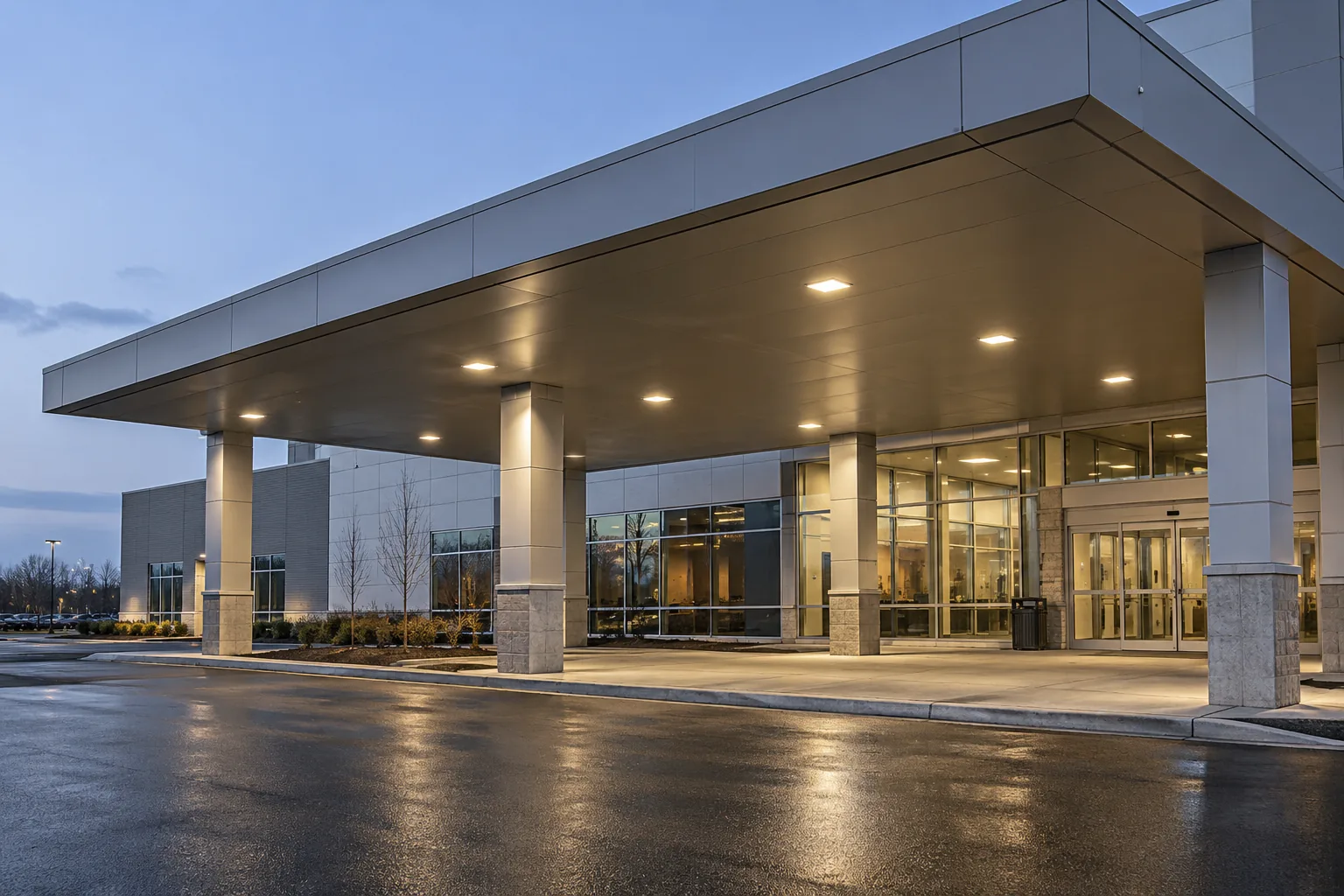
Identify the space beneath the structure
A deep entrance canopy, a narrow storefront soffit and a covered service area have different lighting needs. The first may guide visitors toward doors, the second may illuminate a public walkway and the third may support deliveries or staff access. Identify the task before selecting a recessed or surface-mounted fixture.
Record the canopy depth, height and shape, plus the location of doors, signs, columns and glazing. Projecting features can interrupt coverage, while a shallow soffit may offer limited space for equipment. The layout below also matters: furniture, planters, queues and parked vehicles can change how people move through the illuminated area.
Commercial properties in Mississauga include many building types and construction periods. An existing recessed opening does not establish that a modern replacement will fit appropriately or serve the same area. Start with the physical conditions and the intended result so product selection follows the site rather than forcing the site around a preferred fixture.
Review the existing installation before specifying replacements
Older canopy lighting may use several fixture types or replacement lamps introduced over time. A line of fittings that looks consistent from below can contain different drivers, light sources or controls. An inventory should capture the existing arrangement sufficiently to identify compatibility and access questions.
For recessed equipment, assess the opening, available depth and method of support. For surface fixtures, review the mounting surface and the space available around the enclosure. These details can influence whether a replacement is direct or needs additional work. They should be verified by people with appropriate access and qualifications, without asking property staff to dismantle equipment.
Condition also matters. Corrosion, water staining, damaged lenses and loose trims may indicate a broader issue than a failed light source. If the surrounding building assembly needs attention, define that responsibility separately. A lighting change should not conceal unresolved conditions that may affect the replacement installation.
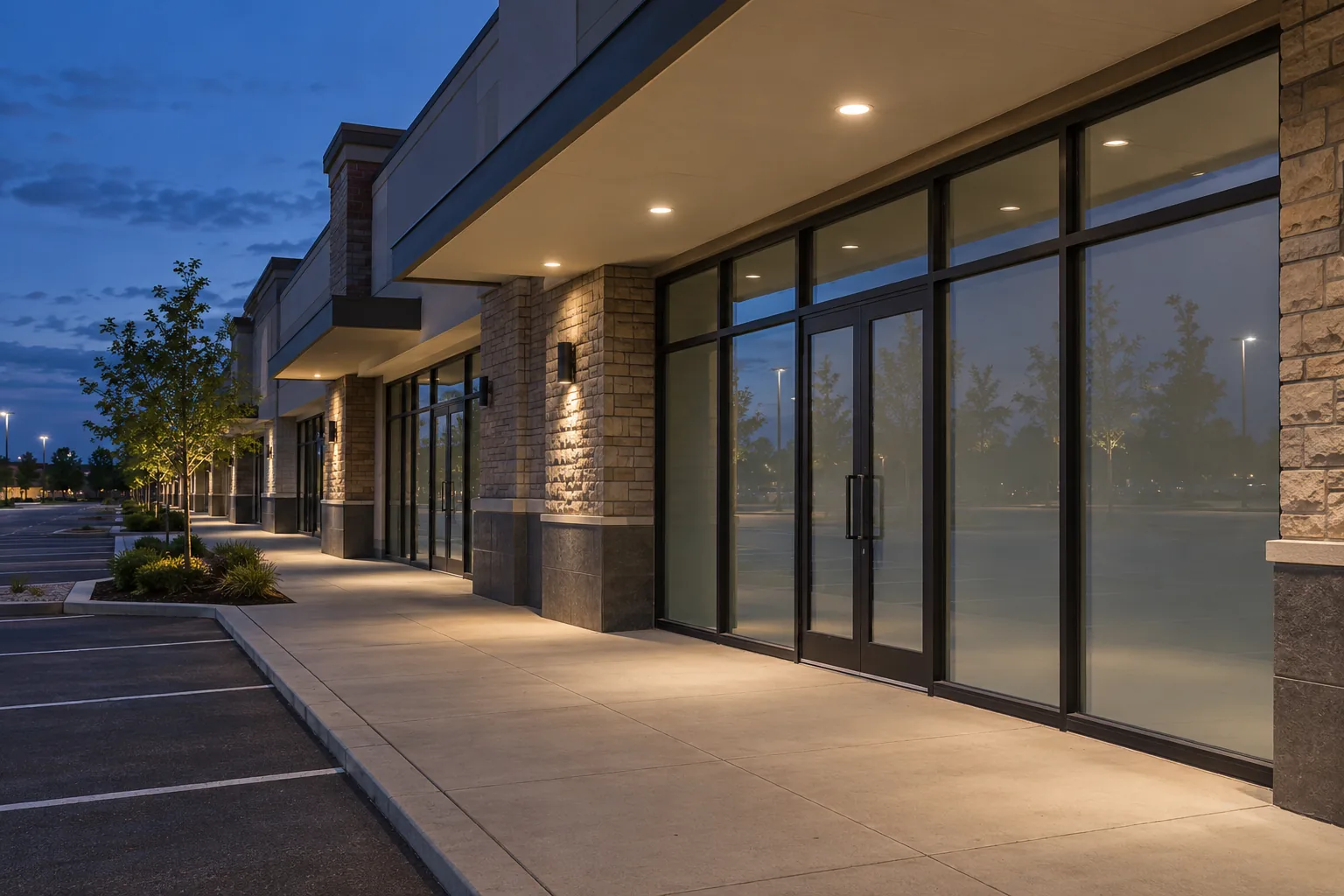
Create useful illumination without a harsh line of bright points
Canopy fixtures are often visible from a distance and at shallow viewing angles. A series of exposed bright sources can become uncomfortable from the approach even when the area below is not uniformly lit. Review shielding, source appearance and the distribution at the proposed mounting height.
The spacing should reflect the geometry beneath the structure. Closely spaced narrow beams can create repeated bright circles separated by darker gaps. A broad distribution may suit one canopy but send unwanted light beyond another. Uniform product appearance does not guarantee uniform coverage when doors, columns and soffit depths vary.
Consider the façade and entrance together. The light should help people recognize the route and doorway without competing unnecessarily with signs or producing strong reflections in glass. Where the covered area joins an open path, coordinate with entrance and walkway lighting to create a coherent approach rather than an isolated bright ceiling.
For canopies near homes, Section 18 of the City’s Property Standards By-law also addresses preventing exterior sources from shining directly into dwelling units. Check the outward view from beneath the canopy, especially where a replacement has a more exposed source or a different distribution.
Match the fixture to moisture and temperature exposure
A sheltered location is not automatically a dry interior. Wind-driven rain, condensation, seasonal temperature changes and nearby washing can affect canopy and soffit equipment. Selection should reflect the actual exposure and the relevant product rating rather than assuming the roof above provides complete protection.
Moisture marks around an existing fitting deserve investigation. The source may involve the building assembly or local conditions that fixture replacement alone will not correct. Coordinate any required roofing, sealing or envelope work with the appropriate trade before treating the lighting installation as complete.
Heat and ventilation conditions can also differ between recessed and surface-mounted positions. Review the manufacturer’s installation requirements for the selected equipment and the actual space available. A fixture should not be chosen only because its trim covers the old opening. Suitability, mounting and service access need to be considered together.
Separate fixture faults from control behaviour
Canopy lights may operate through a shared photocell, time schedule, tenant switch or building control. If the entire row stays on during the day or fails to start at night, review that shared arrangement before assuming every fixture has failed. If one unit flickers or remains dim while adjacent lights operate normally, the investigation may follow a different path.
Describe when the issue occurs and whether it affects the complete canopy or a particular section. Some properties have more than one operating zone even though the fixtures look identical. Clear location information helps avoid confusion between an intentional schedule difference and a fault.
Photocell and exterior lighting controls assessment can address daylight response and shared control problems. If new dimming or scheduling is proposed, confirm compatibility with the chosen fixtures and establish the intended sequence before equipment is installed.
Plan access around occupants and storefront operations
Working beneath a canopy can affect the very route people use to enter a building. Access planning should identify a suitable work area, pedestrian routing and the timing of deliveries or customer peaks. A small quantity of fixtures can still require careful coordination if they sit above the only practical entrance.
For plazas and multi-tenant buildings, clarify who authorizes the work and who communicates with affected businesses. A landlord’s exterior lighting project may overlap with signs, storefront improvements or tenant-controlled equipment. These interfaces should be identified before scheduling, particularly when fixture positions or operating hours are changing.
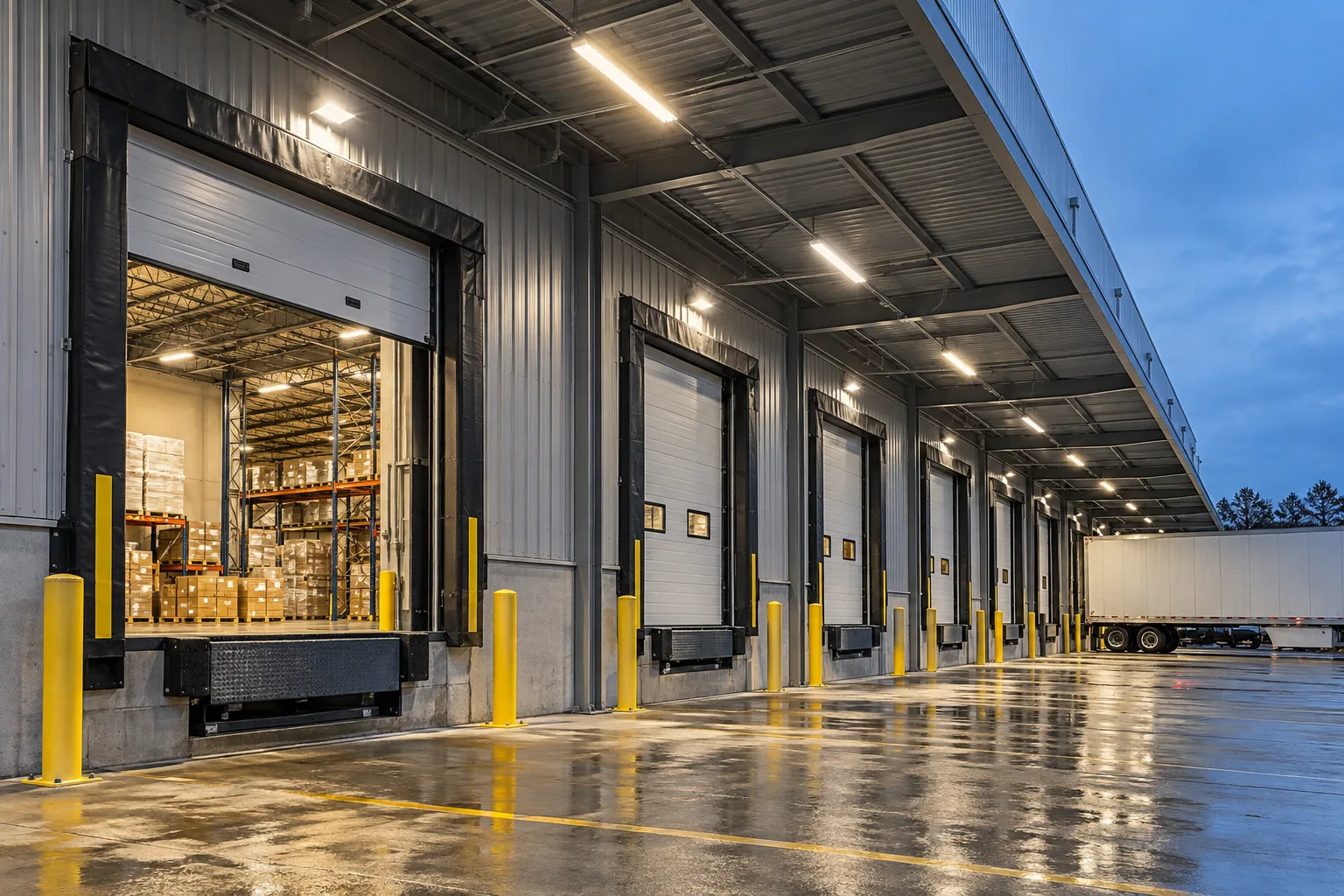
Covered loading or service areas require a different access review from public entrances. Vehicle clearances, delivery windows and equipment movement all matter. Where the canopy forms part of a loading operation, coordinate the lighting scope with loading dock lighting so the area underneath and the approach are considered together.
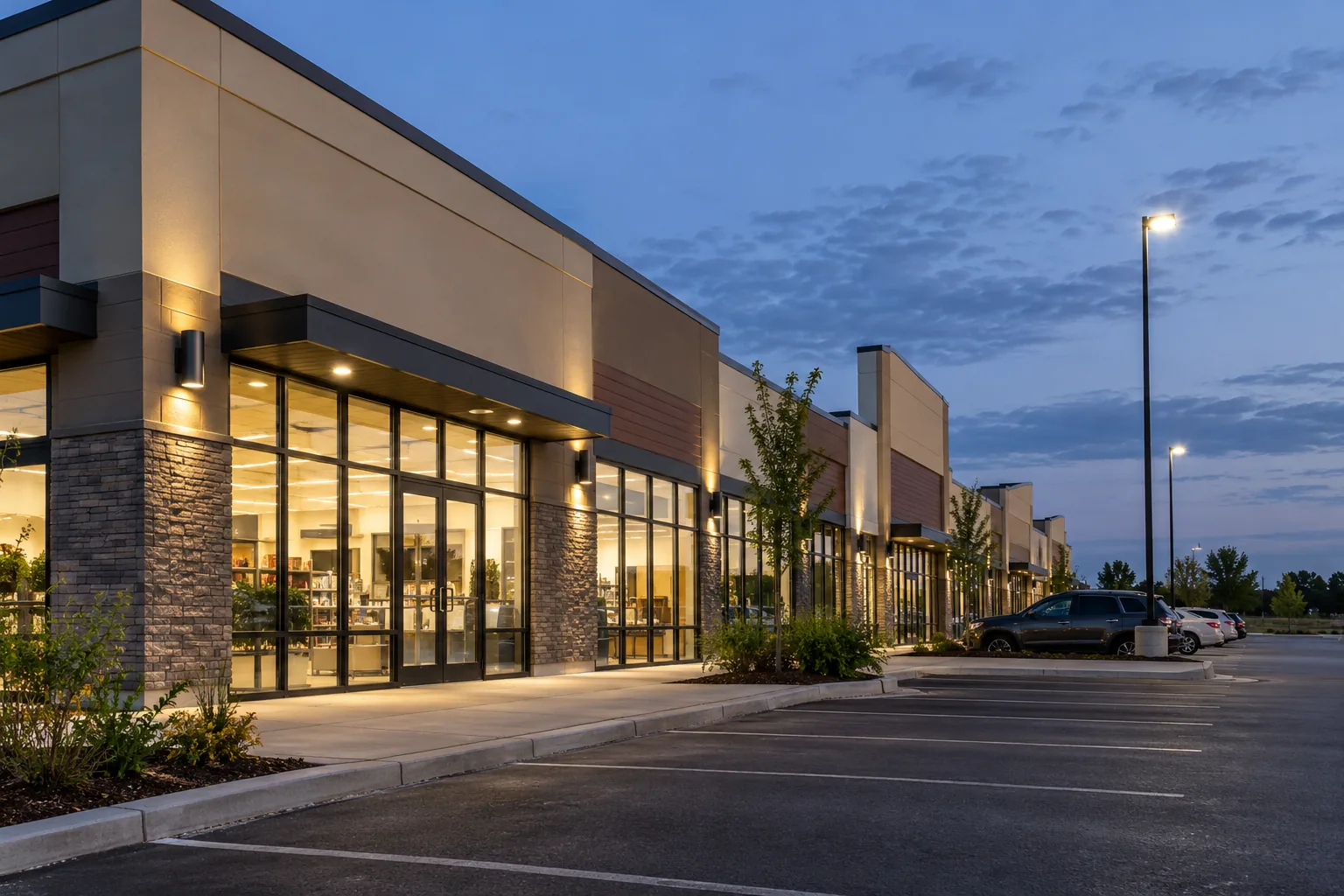
Choose a repair or replacement scope with a clear purpose
Repair may be appropriate when the installation still serves the area well and compatible parts are practical to obtain. A coordinated replacement becomes more relevant when the fixtures are deteriorating, the appearance is inconsistent or the existing distribution does not support the space. Explain the reason for the recommendation in terms of condition and performance.
For a commercial LED replacement, consider the complete fixture arrangement rather than comparing lamp wattages alone. Operating hours, control behaviour, access effort and future maintenance all affect the decision. The commercial LED retrofit process can organize these considerations when canopy work forms part of a broader building upgrade.
Send the property address, photographs of the canopy and fixture layout, approximate quantity and height, known equipment details and the desired timing. Describe any recurring failures or concerns about glare, dark areas or inconsistent colour. A site assessment request should also identify access restrictions and whether management is considering a single entrance, a complete frontage or several buildings.
Where the scope involves hired electrical work, confirm the contracting business through the process described in ESA’s property owner guidance. Establish notification and review responsibilities for the actual work before installation, including any changes to circuits or controls.
Questions facility managers ask
Can existing recessed canopy lights be replaced with LED?
Potentially, but the existing opening, available depth, mounting method, supply and exposure conditions need review. A suitable replacement must fit and operate correctly while providing an appropriate distribution below the canopy. Some locations may require additional work beyond changing the visible fitting.
Why are canopy lights operating during daylight?
The cause may involve a shared photocell, timer, override or wiring arrangement rather than the fixtures themselves. Record whether every light in the group behaves the same way and when the condition began. That information helps direct a qualified investigation of the control sequence.
Should canopy lights match the wall packs on the building?
They should be coordinated visually and operationally, but they may need different optics, mounting and output. Canopy fixtures serve the sheltered area below, while wall packs may cover a wider exterior zone. Review their interaction and colour appearance without forcing one product type into every location.
Can one canopy be upgraded before the rest of the frontage?
A staged approach may be practical where the electrical arrangements and access support it. Establish the intended fixture family, colour appearance and controls for the whole frontage first. Then document the completed section and the equipment retained elsewhere. This helps subsequent work remain consistent and makes it easier for building staff to distinguish the temporary mixed arrangement from the intended final system.