

Assess the property after dark and during the day
Daytime inspection reveals fixture condition, access routes, mounting locations and obvious physical obstructions. It does not show how the property actually looks when the lighting operates. Evening observations can reveal dark transitions, uncomfortable brightness, failed zones and light directed beyond the intended area. Both perspectives are useful when defining the scope.
Begin with a property plan or a simple location record. Identify customer entrances, staff access, parking, loading, service lanes, walkways and waste areas. Note when each is used and by whom. A business that closes early may still receive deliveries or have cleaning staff on site later, so the lighting schedule should follow real activity rather than assumptions about posted opening hours.
Separate the different exterior lighting tasks
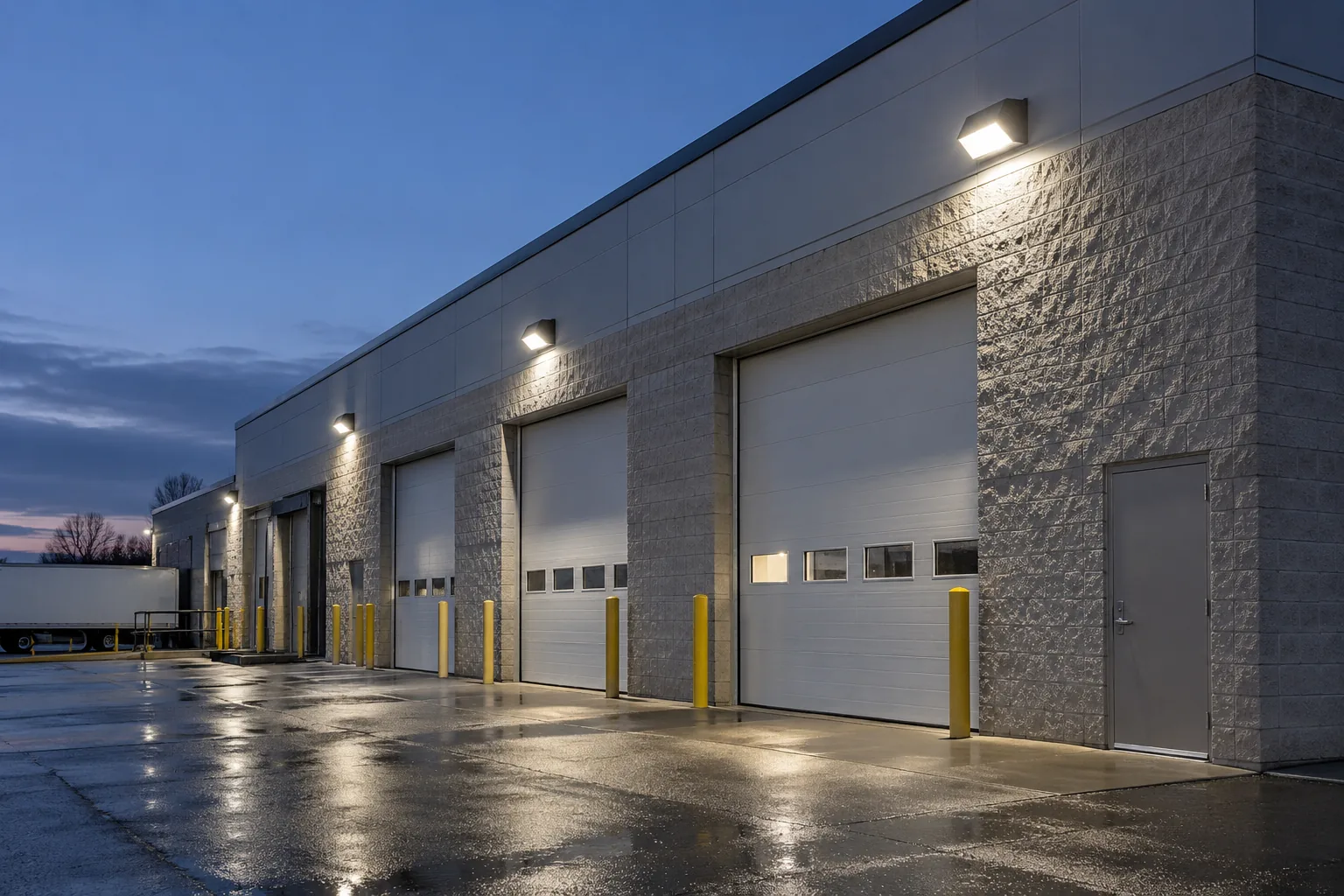
Pole-mounted parking fixtures, wall packs, canopy fittings and entrance lights have different mounting conditions and distributions. Treating them as interchangeable products can create uneven coverage or direct light where it is not useful. The assessment should describe the task for each area and the relationship to neighbouring zones.
For example, parking lot lighting must consider vehicle and pedestrian movement, while entrance and walkway lighting focuses on the route people use near doors and changes in level. Loading dock lighting involves working activity and vehicle geometry. A coherent site plan connects these tasks without forcing one fixture type to serve all of them.

Review distribution before increasing output
A property can contain powerful fixtures and still have areas that are difficult to use. Light may concentrate close to a building, miss an aisle or produce strong contrast between adjacent zones. Mounting height, direction, optical distribution and physical obstructions all affect where the light reaches.
Before adding output, identify the actual problem. Is an area dark because a fixture is out, because trees or structures block it, or because the distribution never suited the task? Is discomfort caused by a bright source in a normal line of sight? A layout or product change may address those issues more effectively than a larger replacement in the same position.
Consider neighbouring properties and the public realm
Exterior lighting does not stop at a property line. Fixtures may be visible from nearby homes, offices, streets and neighbouring businesses. Record existing concerns about brightness or spill, including the position from which the problem is observed. Direction, shielding, mounting and distribution should be considered together when reviewing alternatives.
Current City of Mississauga requirements and any property-specific approvals need to be checked for the intended work. A general assessment of lighting quality is not a legal determination. Where the project raises questions about applicable rules, obtain the relevant direction through the appropriate municipal or professional channels before the design is finalized. Addressing external effects early helps avoid selecting equipment that later needs substantial adjustment.
Mississauga’s Nuisance Lighting By-law addresses private-property glare and light trespass. The Property Standards By-law also addresses safe working lighting and exterior sources shining directly into dwellings. Information reviewed: September 30, 2026.
Distinguish fixture failures from control failures
A single dark fixture and an entire zone that fails to switch on may have very different causes. Exterior lights remaining on during the day can also point to a control problem rather than a need for brighter or more efficient fixtures. Record which lights are affected, when the behaviour occurs and whether it changes with weather or time.
The installation may use photocells, timers, contactors or other control arrangements. Their condition and settings should be reviewed as part of diagnosis. Photocells and exterior controls deserve particular attention where operating behaviour is inconsistent. Do not repeatedly replace luminaires without considering the system controlling them.
Account for weather and the mounting environment
Exterior equipment is exposed to conditions that vary by location. A fitting under a protected canopy has a different environment from one mounted on an open wall or a pole in a parking area. Moisture exposure, debris, temperature conditions and physical damage history can all inform product selection and maintenance planning.
Visible deterioration or damaged mounting should be included in the assessment scope. Replacing the light source does not resolve a problem with the support or surrounding building material. Pole condition, wall attachment and access arrangements may require further review by appropriate personnel. Avoid assuming the existing installation is suitable for a new fixture simply because it has supported the old one for some time.

Plan safe, practical access
Exterior access can involve parked vehicles, loading operations, landscaping, overhead obstructions and changing ground conditions. Document fixture and pole heights if known, but do not attempt to measure them by climbing or opening equipment. Photographs and existing drawings are useful starting information.
Agree how work areas will be separated from vehicles and pedestrians, and who can arrange temporary parking restrictions or tenant notifications. A fixture close to a busy entrance may require a different work window from one in an unused service area. Access assumptions should appear in the scope because they influence the work method, sequence and overall cost.
Choose repair, selective replacement or a phased upgrade
The right response depends on condition, failure history, distribution and operational priorities. A recent installation with one defined fault may warrant repair. A group of aging fittings with repeated failures may be a candidate for coordinated replacement. A property with poor distribution may need layout changes as well as new products.
Compare these options in terms of the whole installation. Retained equipment, controls, access and visual consistency all matter. Commercial lighting repair and LED retrofit planning are complementary pathways. Neither should be presented as the answer before the facility conditions and the customer’s immediate priorities are understood.
Use operating schedules deliberately
Exterior lighting often has several purposes at different times of night. Customer areas, staff entrances, deliveries and property access may not follow the same schedule. Establish the intended operating sequence and any exceptions, then review whether the existing controls support it reliably.
Where dimming or scheduled changes are being considered, discuss the affected activities and the suitability of the fixture-control combination. Settings should be documented and understandable to the person managing the property. A complicated system with unclear responsibility can be harder to maintain than a simpler arrangement. Changes in tenant hours should trigger a review of schedules rather than leaving the installation on an outdated pattern indefinitely.
Define a maintainable property standard
Property managers benefit from knowing which fixtures are installed, how they are controlled and where repeated problems occur. A basic inventory can include fixture identifiers, product details, mounting locations and the dates of previous work. This helps distinguish a widespread equipment issue from a recurring problem at one position.
Standardization may reduce unnecessary variation, but it must respect the different tasks across the property. A wall pack, a canopy light and a parking fixture need not be the same product family to form a coherent plan. The property management lighting approach can organize repair priorities and future phases around the site’s actual maintenance burden.
Prepare a complete exterior assessment request
Provide the Mississauga property address, facility use, hours of activity and the areas involved. Include a site plan if available, photographs from safe accessible positions, approximate fixture quantities and any known control details. Explain whether the concern is failure, uneven lighting, excessive brightness, neighbour impact or a planned upgrade.
Mention deliveries, access restrictions, tenant coordination and any previous work related to the problem. A useful scope should identify fixtures, controls, mounting considerations, access, removal and assumptions requiring confirmation. This allows the property representative to evaluate operational impact and future maintenance alongside the proposed installation, rather than comparing fixtures without the conditions that make the project workable.
Questions facility managers ask
Does brighter exterior lighting make every property better?
No. Useful lighting depends on where it reaches, how evenly it supports the activity and whether bright sources create discomfort. Increasing output can leave the original dark areas unresolved while adding glare or spill. Review the layout, fixture condition, distribution and surrounding properties before deciding on replacement output. The goal is an appropriate lighting arrangement for the property and its operating needs.
Should an exterior lighting assessment include an evening visit?
Evening observations can be valuable because they show actual operation, transitions and the effect on surrounding areas. Daytime review is still needed for condition and access. The appropriate assessment approach depends on the problem and available information. Photos and observations from the property representative can help identify issues, but they may not capture every condition that needs review.
Can exterior lighting be replaced in phases?
Often a project can be divided by area or fixture group, subject to the technical scope and operating requirements. Plan the overall approach first so controls, colour appearance and distribution remain coherent between phases. Identify temporary conditions and prioritize faults or areas with the greatest operational impact. Each phase should have a clearly defined scope rather than becoming an unrelated replacement exercise.
Why do all the exterior lights stay on during daylight?
A common control arrangement, sensor condition, settings or other system issue may be involved, but the cause cannot be established from the symptom alone. Record the affected zones and when the behaviour occurs, then request lighting service. Do not open control equipment or bypass devices. An assessment can distinguish a control problem from separate fixture faults and establish the appropriate response.
What local requirements apply to a Mississauga exterior project?
The answer depends on the property, the proposed work and any applicable municipal or site-specific requirements. Exterior lighting should be reviewed for its effect on neighbouring properties and public areas, and the relevant current City information should be checked. Where interpretation is needed, obtain direction from the appropriate authority or professional. A generic fixture quotation should not be treated as confirmation of every applicable requirement.