
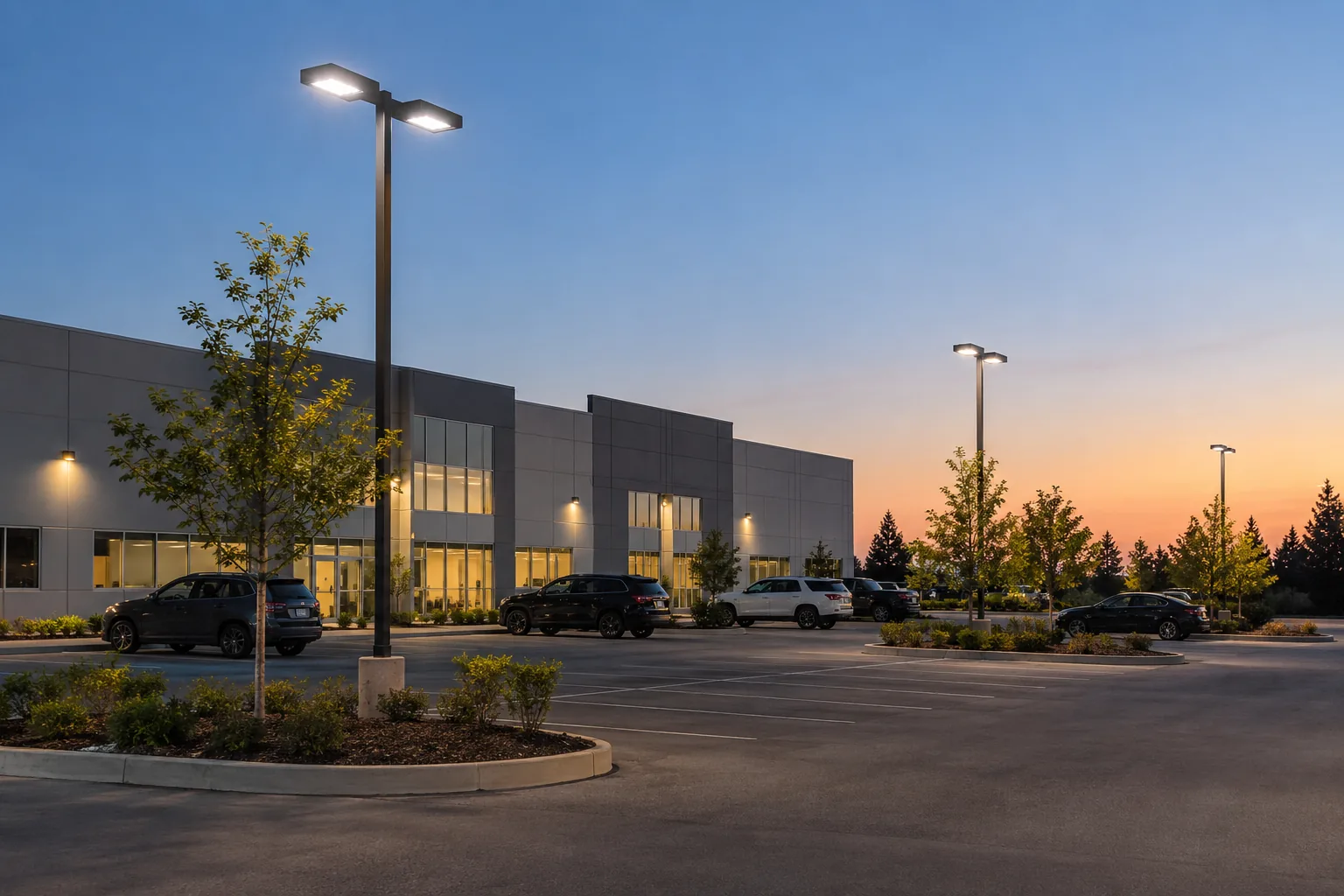
Read the parking area as a working property
A parking lot is rarely one uniform space. Customer bays beside a shopping plaza operate differently from employee parking at an industrial building, a truck staging area or visitor spaces outside an office. A useful assessment maps those activities before considering replacement fixtures. Entrances, pedestrian crossings, accessible parking routes, cart areas, payment stations and changes in grade can all affect where usable light is needed.
Traffic patterns also change through the day. A facility near Gateway may have an early shift arriving before sunrise; an office property along the Hurontario corridor may need strong evening coverage around its main entrance while distant parking becomes lightly used. Those conditions help establish control zones and operating schedules. They do not automatically justify switching off every lightly used area.
Record existing pole positions, building-mounted fixtures and any illumination coming from adjacent properties. Borrowed light can make a weak installation appear adequate during one visit and disappear when a neighbouring tenant changes its hours. The proposed scope should address the property on its own terms, with neighbouring conditions treated as context.
Separate a failed light from a coverage problem
A dark area can be caused by a failed fixture, an interrupted circuit, a control issue or a layout that never provided appropriate coverage. These require different responses. Replacing a failed unit with another of similar output may restore the original pattern but will not necessarily improve a poorly lit crossing between poles.
For service requests, identify whether one head, every head on one pole, a row of poles or the entire lot is affected. Note when the issue appears and whether lights return later. Daylight photographs of the fixture and pole, plus photographs showing the dark area at night, provide more useful context than a single close-up taken from directly beneath the light.
A group failure may involve shared supply or controls; one intermittent unit may have a fixture-specific issue. These observations guide a qualified investigation without establishing a diagnosis remotely. Where outages are the main concern, start with commercial lighting repair and keep any proposed system upgrade as a separate decision with its own reasons and scope.
Compare repair, partial replacement and a coordinated upgrade
Repair can be appropriate where the existing arrangement performs well and a compatible component can restore dependable operation. A wider replacement becomes more relevant when several fixtures are deteriorating, suitable parts are difficult to obtain or repeated access costs are accumulating. Age alone does not resolve that choice; condition, performance and practical serviceability matter together.
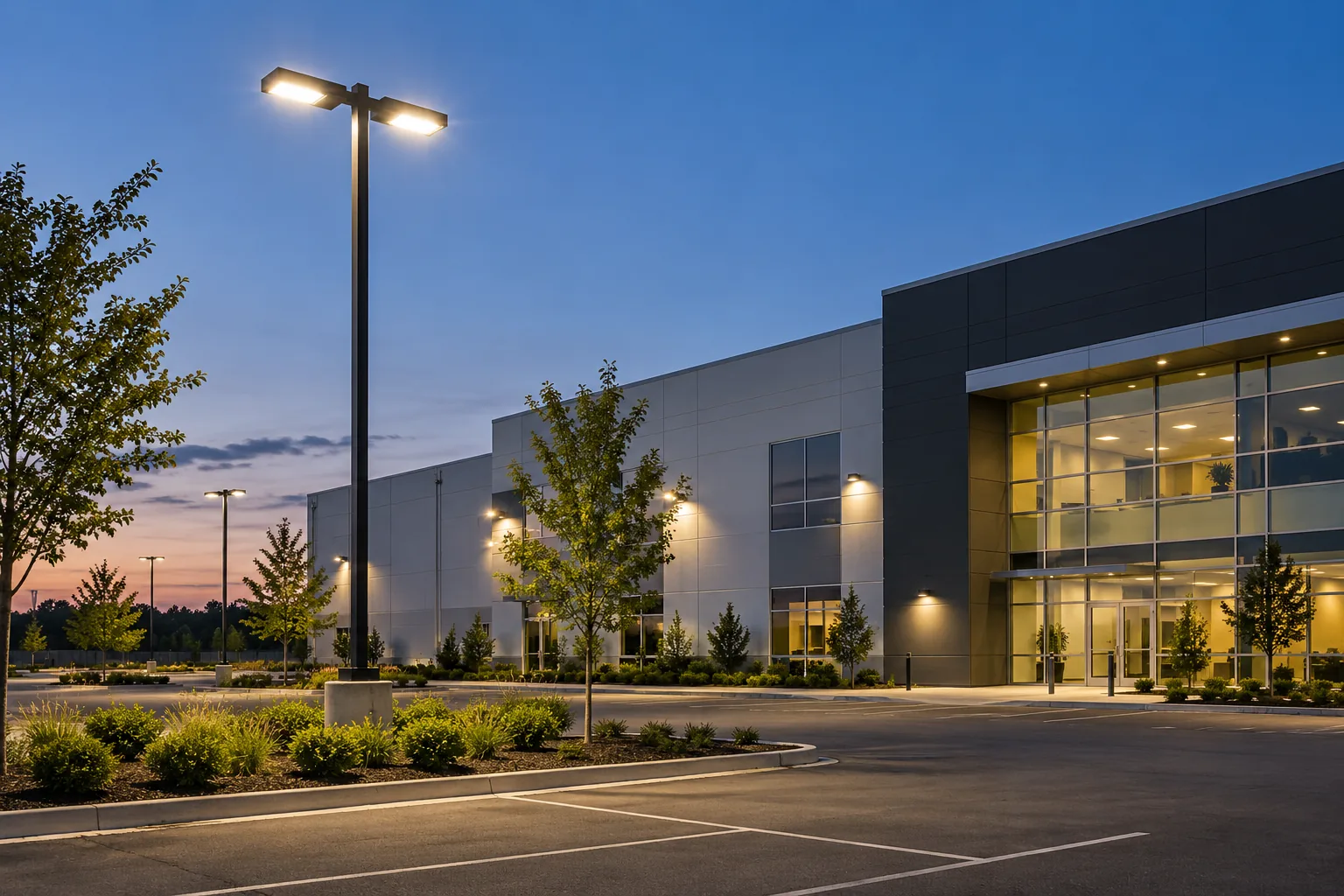
Partial replacement needs particular care. New LEDs beside older sources can create abrupt changes in colour and distribution. A brighter replacement on one pole can make adjacent areas appear darker even when their output has not changed. Review the appearance and coverage of the complete affected zone, rather than evaluating a catalogue image in isolation.
A coordinated LED plan can address fixture consistency, operating wattage and controls, but savings depend on actual loads and hours. It should also distinguish fixture replacement from pole work, circuit work and civil work. These are different cost and access considerations. The commercial LED retrofit process helps build an inventory and compare alternatives before orders are placed.
Choose distribution and aiming around the boundaries
Parking lot fixtures are selected for how they distribute light across the ground, not just their advertised brightness. Pole height, spacing, mounting arrangement and the position of the pole within the lot influence the result. A perimeter pole near a residential boundary has different requirements from a pole between two wide parking aisles.
Evaluate glare from the driver’s approach and from pedestrian eye level. A high-output fixture that sends unnecessary light toward the street or neighbouring windows may perform poorly even if the pavement directly below it looks bright. Shielding, optical distribution and appropriate orientation should be considered before increasing wattage or tilting fixtures upward.
Where the project changes coverage substantially, ask what lighting calculations or design information are appropriate to support selection. A calculation should use the intended mounting heights and actual property geometry. It is a planning tool, not a substitute for checking the installation and its surroundings after dark. Broader commercial exterior lighting planning can coordinate poles with wall-mounted and entrance fixtures so that one system does not undermine another.
Mississauga’s Nuisance Lighting By-law addresses glare and light trespass from private-property lighting. Perimeter-pole selection should therefore consider where light travels beyond the lot, alongside the coverage needed within it. Check any property-specific approval conditions when defining a changed layout.
Plan safe access before a lift arrives
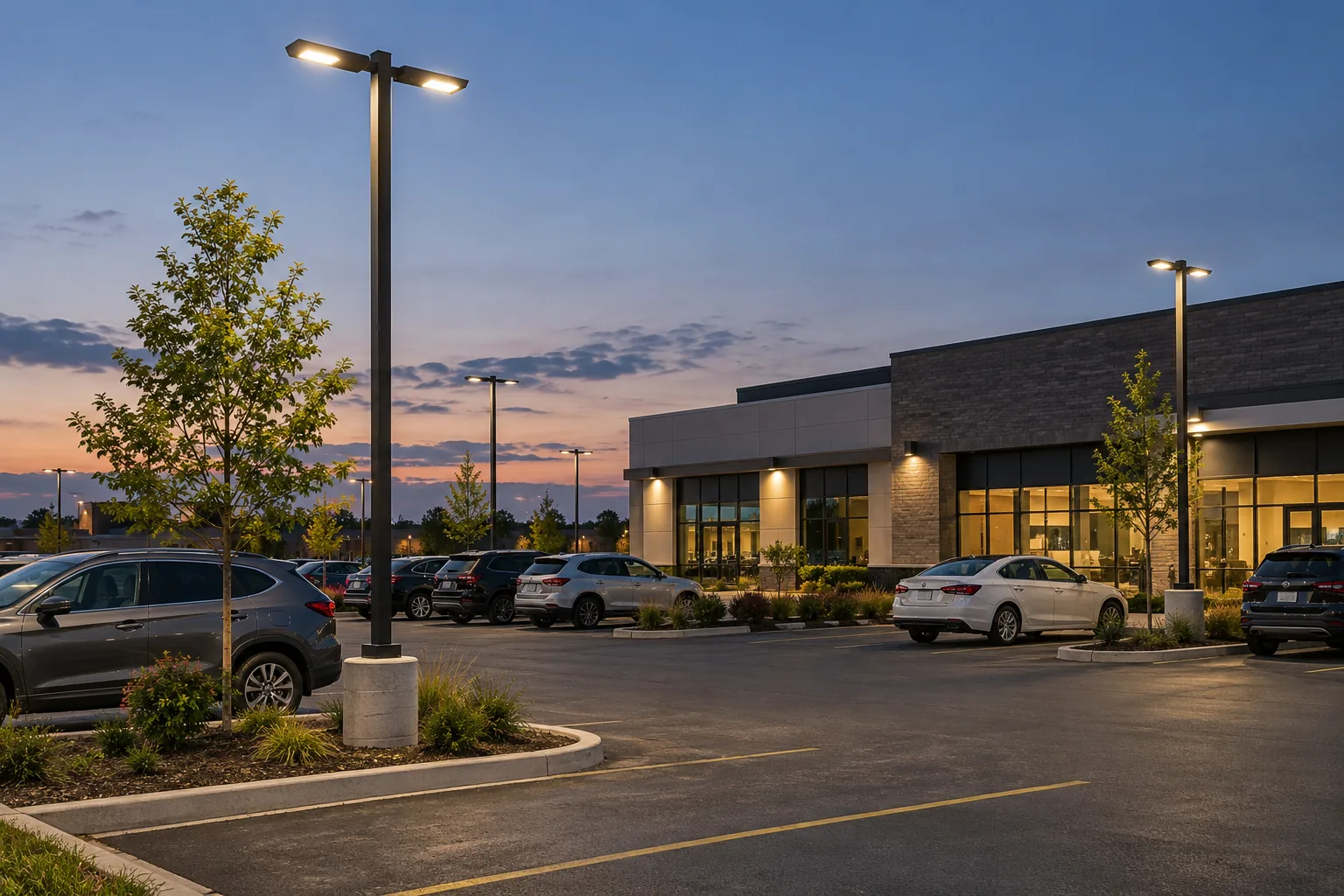
Fixture access may be a larger part of the project than the number of lights suggests. Record pole height, the location of landscaped islands, overhead obstructions, slope, loading routes and the spaces required for access equipment. A pole surrounded by parked vehicles cannot be treated as continuously available during business hours.
Property management should identify who can reserve spaces, notify occupants and authorize temporary changes to circulation. For retail properties, deliveries, accessible routes and customer peaks need to remain part of the schedule. For industrial properties, vehicle size and turning movements can make a seemingly quiet area unsuitable for an equipment setup.
The condition of poles and mounting assemblies also belongs in the assessment. Visible corrosion, impact damage, loose-looking components or a leaning pole should be raised with the appropriate qualified professional. A lighting replacement scope should not silently assume that every supporting structure is suitable for continued use. If structural or underground work is required, define it separately before scheduling the fixture work.
Make the operating sequence explicit
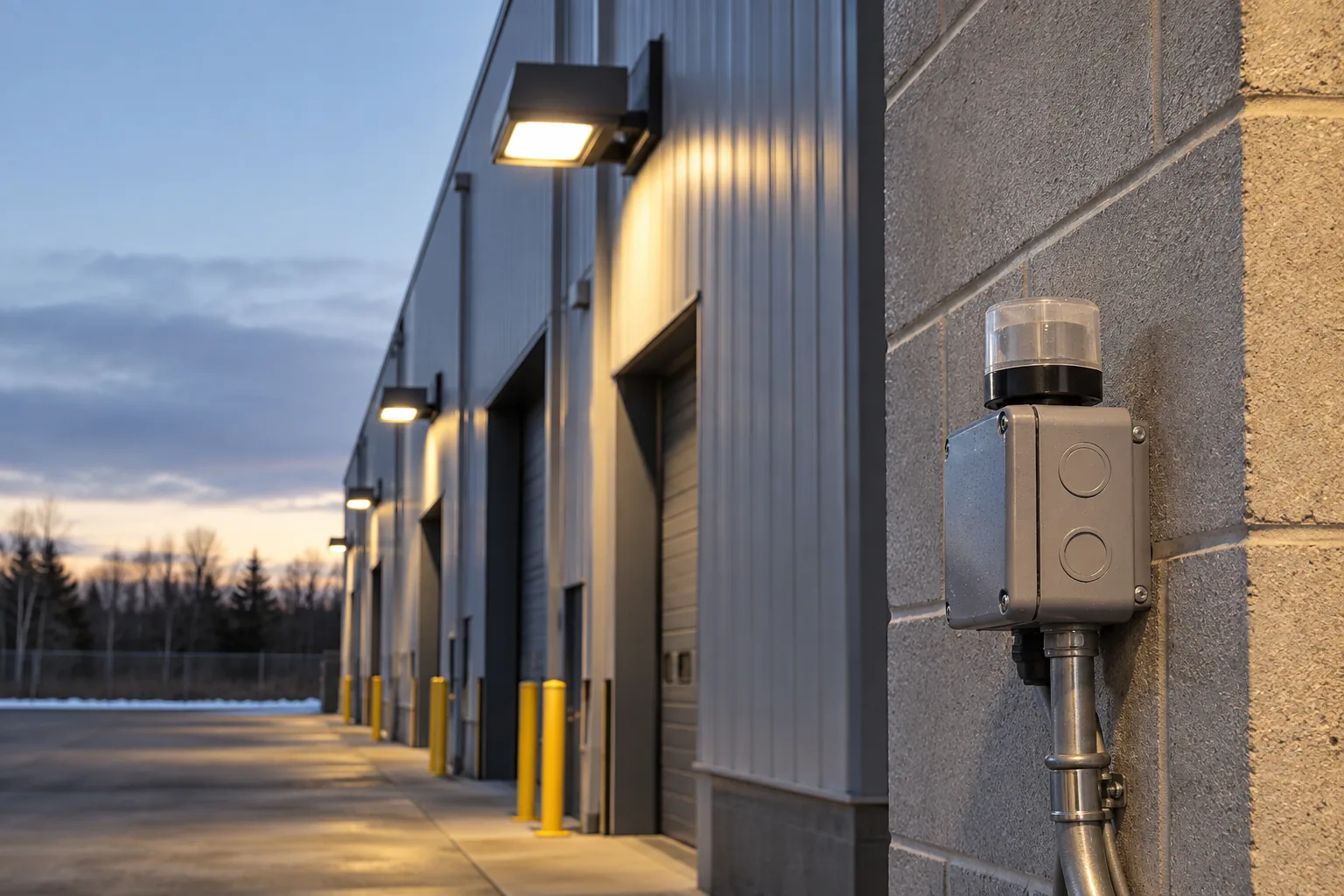
Ask how the lot currently decides when to turn on, reduce output and turn off. The answer may involve a photocell, timer, building controls, local overrides or a combination. If occupants report that lights behave unpredictably, review the operating sequence rather than adding another control without understanding the existing one.
A time schedule alone does not track seasonal daylight. A photocell alone does not distinguish customer hours from overnight operation. Depending on the equipment and site requirements, a coordinated approach may provide more useful operation. Any reduction strategy must still account for access routes, late departures, security activity and other lighting obligations applicable to the property.
Document the intended normal mode, any reduced-output mode and the override process. Include the person responsible for future clock changes or schedule updates. The photocell and exterior controls service addresses control behaviour directly, including lights staying on during the day or failing to start at dusk.
Build a phased scope that is easy to approve
A property may need urgent repairs now and a larger improvement during a later budget period. Separate those priorities in the scope. Identify immediate outages, areas requiring investigation, fixtures suitable for repair and zones where coordinated replacement warrants consideration. This allows management to make a decision without treating every recommendation as an inseparable project.
Phasing works best by coherent area: an entrance zone, a row of parking, a building frontage or an employee lot. Randomly replacing scattered fixtures can make consistency harder to manage. Keep records of the products and control settings used in each phase so later work does not introduce avoidable incompatibility.
For budgeting, clarify whether the proposed scope includes access arrangements, controls, removal of existing equipment, disposal and any follow-up adjustments. Existing underground faults or damaged poles may require investigation before a firm scope can be established. Those uncertainties should be identified as questions to resolve, not hidden inside a general fixture allowance.
Information to provide with your request
Send the property address, approximate number of poles and fixtures, the areas affected and the preferred project timing. Include daytime photographs showing complete poles and mounting arrangements, along with a simple site plan if available. A marked aerial image can help locate recurring outages and routes that need particular attention.
Describe occupancy and access: opening hours, shift changes, delivery windows, reserved spaces, snow storage and any restrictions on equipment. If previous repair records or fixture labels are available, include them. A label photograph should be taken only where it can be obtained safely without opening electrical equipment or climbing a pole.
For an upgrade, explain the objective in practical terms: fewer repeat service visits, more consistent coverage, improved pedestrian routes, more predictable controls or reduced energy use. State whether management needs options for a single area or the complete property. A site assessment request can then focus on decisions that matter to the facility.
Questions facility managers ask
Can one failed parking lot light be repaired?
Potentially. The fixture condition, the nature of the fault, compatible parts and access cost all affect the decision. A fixture outage does not automatically require replacing every light in the lot. If several failures share a supply or control issue, the investigation may need to extend beyond the visibly dark unit.
Does a higher-wattage LED always improve parking lot lighting?
No. Distribution, pole height, spacing and glare matter alongside light output. A powerful fixture can concentrate light in the wrong place or send unnecessary light across a boundary. Selection should consider the intended coverage and property geometry, then coordinate the fixture with adjacent lighting.
Can the work be scheduled while the property is open?
The possibility depends on traffic, equipment access and the areas that can be isolated. Some work can be staged around available spaces; other conditions may call for quieter periods. Confirm access arrangements, pedestrian routing and any temporary lighting needs before agreeing to a schedule.
What happens if the pole itself is damaged?
Raise the condition at the start of the request and keep people clear of an apparently unstable structure. The appropriate qualified assessment may extend beyond fixture replacement. The resulting scope should distinguish pole or foundation concerns from electrical repairs and lighting performance improvements.