
Published September 30, 2026 · Mississauga Commercial Lighting
Describe the outage as a pattern
Record which fittings are affected and when the problem occurs. One light that never turns on is different from a row that shuts off together, a fixture that cycles after warming up or an entire lot that remains dark after dusk. Note whether the issue began after a storm, maintenance visit, schedule change or other known event. Do not treat that timing as proof of the cause, but include it in the service request.
Use a simple site plan or annotated photograph to identify poles and building-mounted fixtures. A description such as the third pole beside the rear loading lane is more useful than a close-up without context. Observe from safe ground positions and avoid opening equipment or attempting access. If damaged equipment or another hazard is visible, follow the property’s safety procedures and arrange appropriate assistance. The immediate task is to communicate the condition clearly so investigation can be planned.
Separate the fixture from the control system
A dark fitting may involve the lamp, driver, ballast, wiring, supply or a control. Where several lights fail together, the shared arrangement deserves attention. A failed photocell, timer setting or control component can produce a widespread outage even when the fixtures themselves are serviceable. Conversely, a working control does not establish that every fitting is healthy.
Tell the service provider whether any lights respond differently, whether manual operating arrangements are known and whether recent time or schedule adjustments occurred. Leave diagnosis and testing to qualified personnel. Avoid ordering replacement fittings simply because the lot is dark; doing so can leave the underlying problem unresolved. The photocell and exterior controls service and commercial lighting repair service address different parts of this investigation. A clear initial report helps establish whether the visit should focus on one unit or a shared system.
Identify the areas that matter most operationally
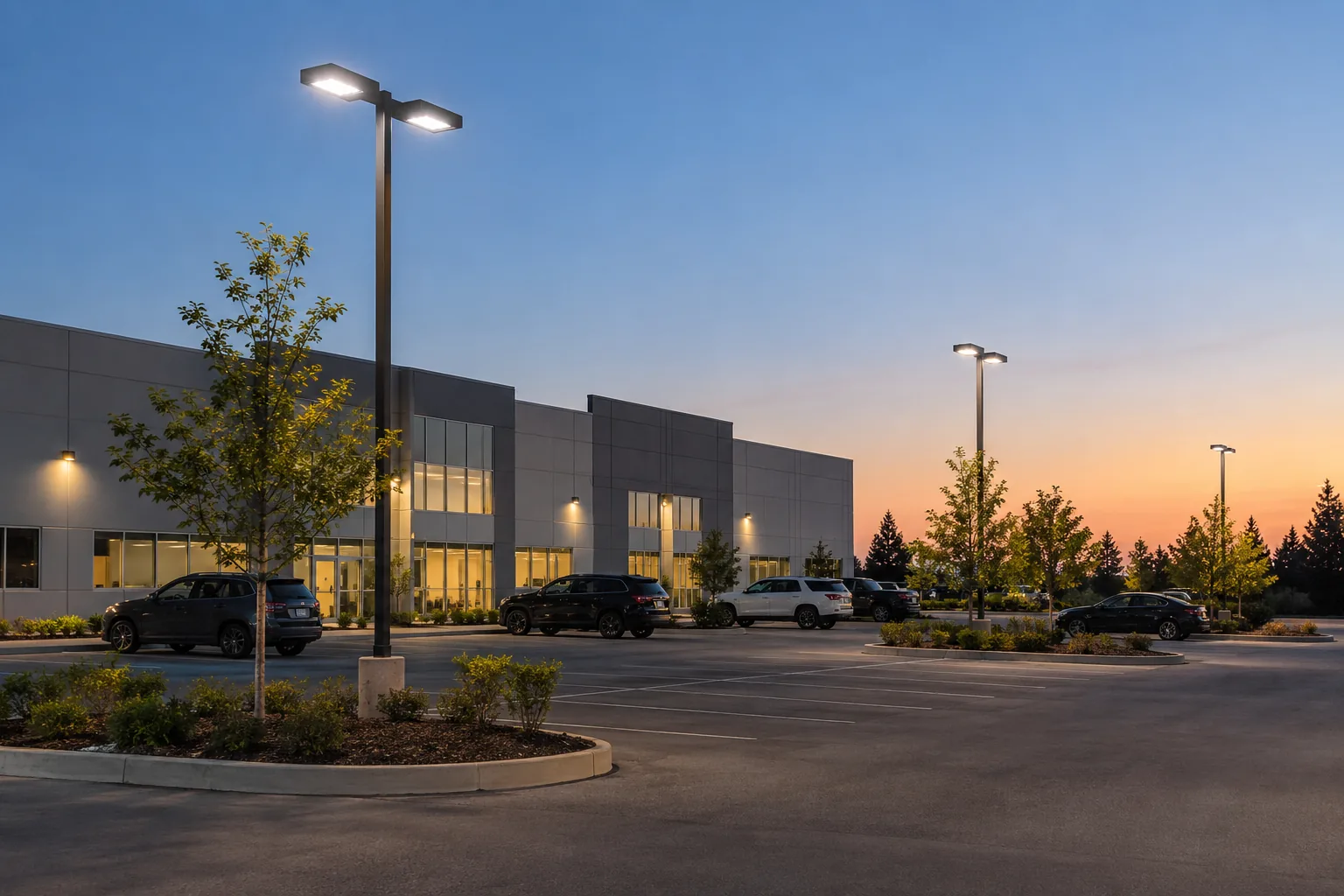
Map vehicle lanes, pedestrian routes, accessible parking, entrances, payment areas, loading interfaces and waste enclosures. Their use can change throughout the evening. A retail plaza may have late-closing tenants, while an industrial property may receive trucks after office staff leave. A simple closing time for the main business may not describe the lot’s actual needs.
Ask property staff where users report dark patches, harsh glare or difficult transitions. Consider the view of a driver approaching an entrance as well as a pedestrian walking between parked vehicles. Trees, signs, canopies and changing parking arrangements can affect distribution. These observations do not establish legal compliance or guarantee security outcomes, but they help define a meaningful scope. A proposal should explain which areas are being addressed rather than assuming that replacing a set number of poles’ fixtures will improve every part of the property equally.
When a targeted repair may be appropriate
Repair can be practical when the fault is isolated, the fixture and mounting arrangement remain suitable and compatible parts are available. Restoring an otherwise serviceable system may be the right immediate decision, particularly when the existing coverage meets the property’s operational needs. Ask what component is being replaced and whether the diagnosis suggests a wider issue that should be investigated.
Consider access cost alongside parts cost. A component that is inexpensive at ground level may involve significant planning at the top of a pole. If other fittings of the same type have a documented pattern of failure, discuss whether additional inspection or coordinated work would be useful during the visit. That does not justify replacing sound equipment indiscriminately. A repair decision should reflect evidence about condition and future servicing, not a blanket statement that old technology must always be discarded.
When coordinated replacement becomes more useful
A wider replacement plan may be worth considering when several fixtures have deteriorated, parts are hard to obtain, output is uneven or maintenance visits are frequent. It may also be appropriate when the lot’s use has changed and the old distribution no longer supports important routes. Replacement should address those conditions explicitly rather than merely substitute LED equipment at every existing point.
Compare the proposed distribution, mounting compatibility, colour appearance and control behaviour. Existing poles and electrical infrastructure may be retained only where suitable for the proposed work. Their condition needs consideration; a new luminaire does not repair a damaged pole or resolve an unsuitable mounting arrangement. Identify any investigation, structural input or other work required outside the lighting replacement. A phased capital plan can separate urgent restoration from a longer-term upgrade, helping a property manager explain priorities without presenting every outage as an immediate full-site project.
Review glare and neighbouring properties
Exterior lighting needs to illuminate the intended property while considering people beyond it. A brighter fitting or a changed aiming angle can increase unwanted light at nearby windows, roads or adjoining businesses. Review the boundary conditions, the direction of the source and any shielding or distribution options before making the change.
The City of Mississauga’s Nuisance Lighting By-law addresses glare and light trespass from private-property lighting. Use the current City guidance and any site-specific approvals when defining the scope. Do not assume that an energy-efficient fixture automatically resolves nuisance lighting concerns. A nighttime review can help show where light actually falls, particularly beside residential properties. This is a planning consideration rather than a legal opinion or a promise of compliance from a photograph. Information reviewed: September 30, 2026.
Plan access around traffic and parked vehicles
Pole lighting work may require access equipment, clear positioning space and separation from pedestrians and vehicles. Identify the entry route, overhead obstructions, ground conditions and any delivery or parking restrictions. Snow storage, landscaped islands or tightly parked vehicles can complicate access even when the pole is easy to see.
Agree who clears the affected area and how notice is provided to tenants or users. A plaza may need coordination across several businesses rather than approval from one tenant. An industrial site may need to protect a truck route during loading hours. After-hours work can help in some situations, but darkness, security and site staffing still need planning. Confirm the method and operating window in the agreement. An accurate access description helps avoid a visit that cannot proceed because the equipment cannot reach the fixture or the work area cannot be secured.
Set an exterior controls strategy
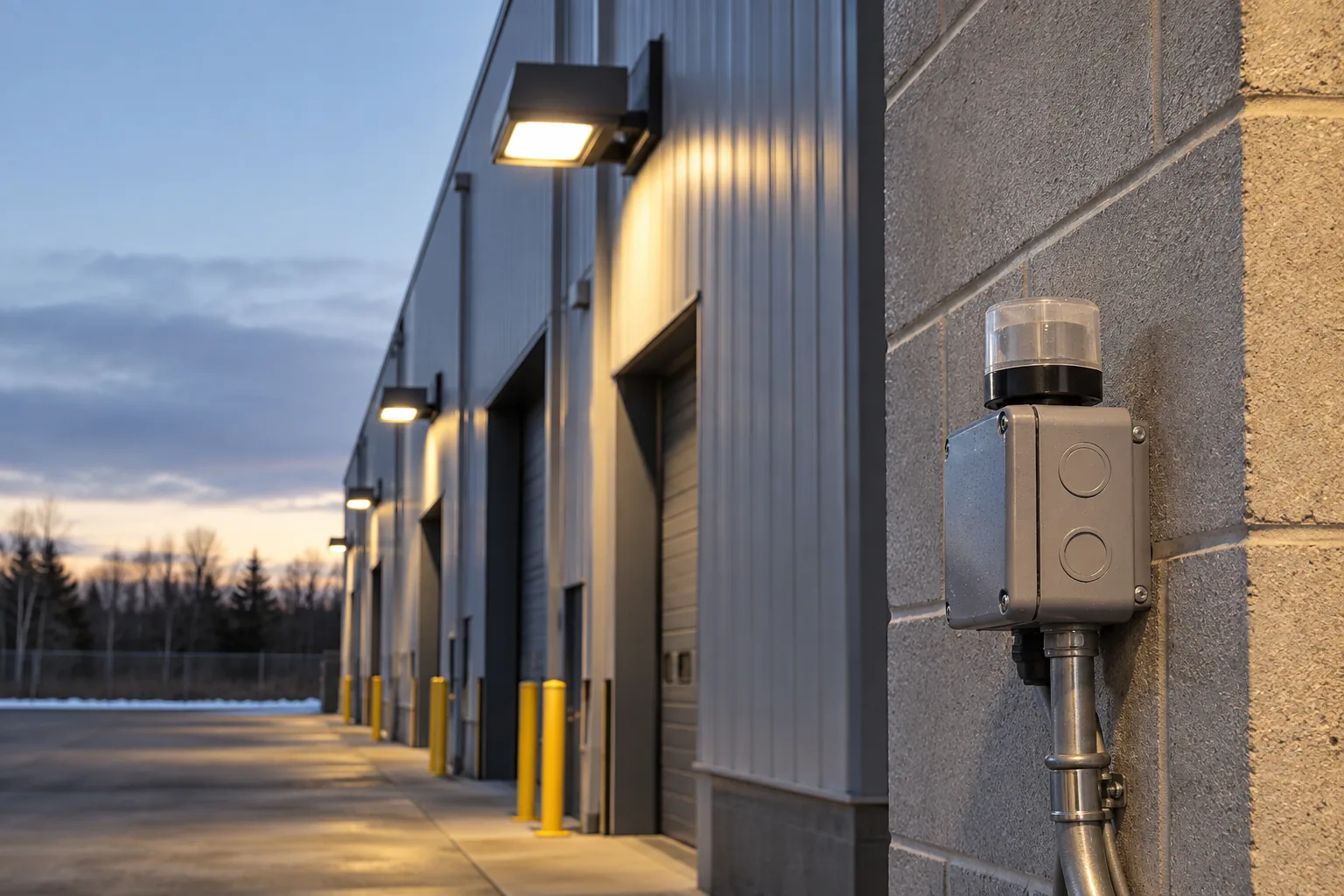
Review when each part of the property needs illumination. Entrances serving late tenants, loading areas and general parking may not share the same schedule. Photocells can respond to ambient light, while schedules can reflect operating patterns; the appropriate arrangement depends on the property and equipment. A control plan should also describe manual overrides and responsibility for adjustments.
Investigate persistent daytime operation and missed nighttime operation as control problems, not automatically as fixture failures. Sensor location, changing surroundings, settings and equipment condition may all be relevant. Do not move or bypass controls without appropriate assessment. After work, confirm behaviour under the conditions it is meant to respond to, including a suitable review after dark where needed. Keep the accepted settings and control locations in the maintenance record so a later service provider does not need to rediscover the operating arrangement from scratch.
Compare costs across the expected work
Request a scope that identifies fittings, parts, access, labour, removal, disposal and control work. Where replacement is proposed, ask what is retained and what uncertainties remain. If a fixture cannot be sourced, a substitute should be evaluated for distribution and compatibility rather than wattage alone. Keep immediate repair costs separate from optional improvements so the decision remains clear.
Energy estimates should use the actual operating schedule and system input information. Do not apply an indoor warehouse incentive assumption to an exterior pole fixture; the precise product and current program category need verification. Maintenance expectations should also be based on the selected equipment and access conditions, with written product or project terms where offered. A comparison that acknowledges these details is more useful than a headline saving or an unsupported claim that the new installation will be maintenance-free.
Close the job with a usable property record
Give each pole or lighting position a stable reference on the site plan. Record the equipment installed or repaired, the date, control settings and any outstanding observations. This helps property managers identify repeat failures and gives a future service request useful context. Keep documentation with the property record rather than only in an individual employee’s inbox.
Review the original problem under normal nighttime use once the work is complete. Check the affected pedestrian and vehicle areas, obvious glare concerns and control behaviour. Any required measurements or formal design verification should be defined in the project scope. For the first discussion, send the Mississauga address, a location plan, approximate pole height if known, photos, affected quantities and preferred access windows. The parking lot lighting service can help frame either a repair request or a planned replacement assessment.
Questions facility managers ask
Does one failed pole light mean the others need replacement?
No. Start with the diagnosed fault and the condition of the remaining system. A coordinated upgrade becomes a separate decision when performance, repeated failures or servicing constraints justify it.
Can the existing poles stay?
Potentially, subject to their condition and compatibility with the proposed equipment and installation method. The scope should identify any pole or mounting concerns rather than assume a luminaire change addresses them.
Can a daytime visit resolve a nighttime complaint?
Some investigation can happen during the day, but control behaviour, distribution and glare may need assessment under nighttime conditions. Describe when the problem occurs so the visit and any follow-up can be planned.