
Published November 27, 2026 · Mississauga Commercial Lighting
A useful commercial lighting maintenance checklist for Gateway facilities does more than count burned-out lights. It creates a repeatable way to record where a problem occurs, how the lighting is supposed to operate, what access is required and whether a repair is isolated or part of a recurring pattern. That information helps facility teams act on current deficiencies without losing sight of longer-term planning.
At Mississauga Commercial Lighting, we provide commercial lighting maintenance for facilities that need a clearer approach to fixture records, recurring faults, controls and access planning. The checklist below is designed for the building team members who notice and report conditions, not for anyone to open equipment, bypass controls or perform electrical work.
1. Build a maintenance record that survives staff changes
Start with the locations where lighting problems create the most disruption. That could be high-mounted fixtures over racking, a garage level, a common corridor, an entrance route or a specific group of unreliable fixtures. The record does not need to begin as a complicated database. A labelled plan and a shared spreadsheet can be enough when they use the same references consistently.
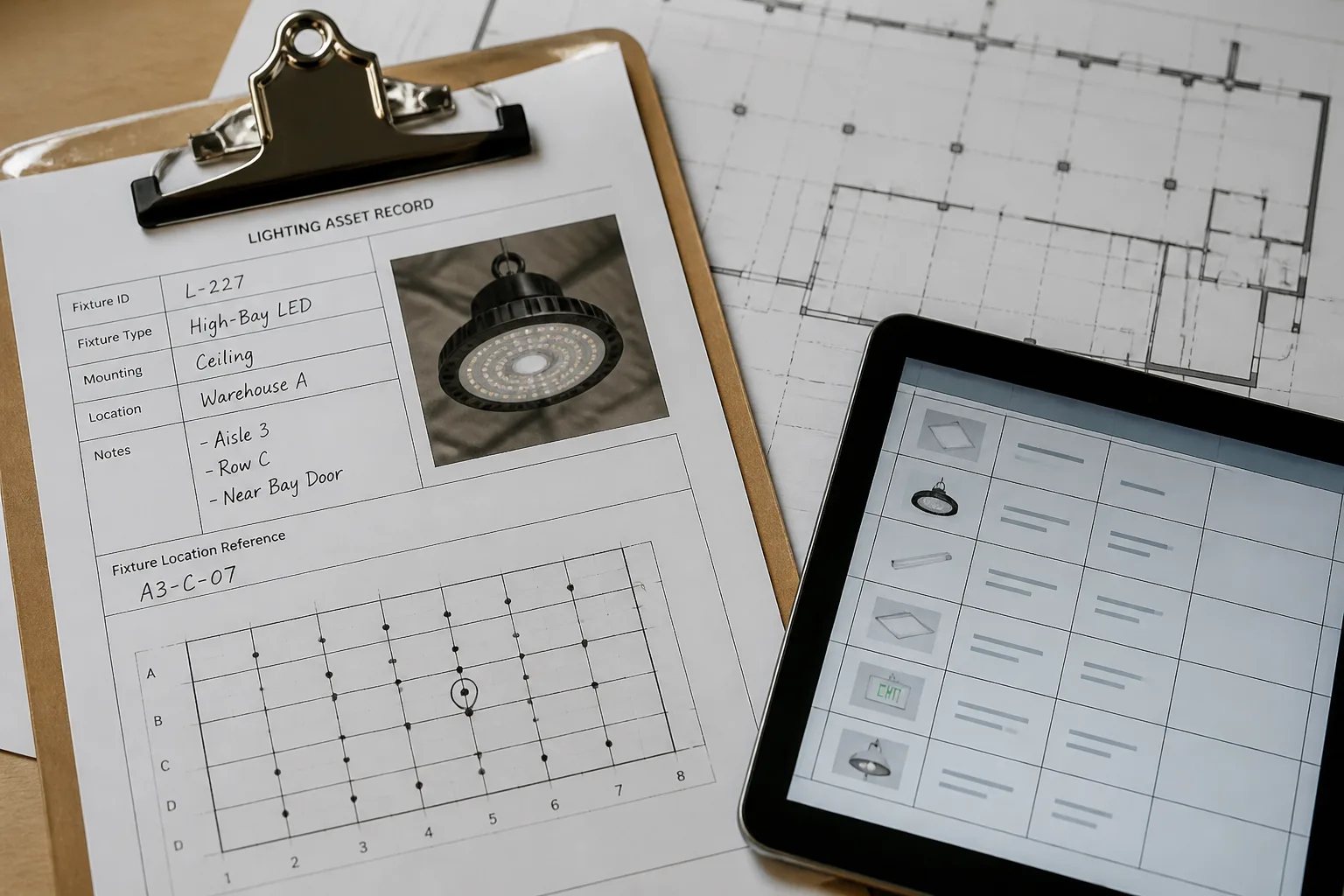
For each fixture or fixture group, record what is known:
- A clear location reference, such as an aisle, level, corridor or exterior zone
- Fixture type and known model information
- Mounting height or access conditions
- Associated controls, including sensors, timers or schedules
- Date and description of significant repair or replacement work
- Photos taken from a safely accessible position, where useful
Mark uncertain details as unknown rather than guessing. Similar-looking fixtures can use different drivers, lamps or control arrangements. A record that preserves uncertainty is more useful than one that sends a future service request in the wrong direction.
2. Report the symptom and operational impact
A report such as “lights are out” rarely provides enough context to plan work. Describe what occupants can actually see: completely out, intermittent, unusually dim, different in colour, visibly damaged, operating at the wrong time or not responding to the expected control. Also note whether the issue affects one fitting, a row, an aisle or an entire zone.
The timing matters. Flicker that occurs only after extended operation, lights that remain on during daylight, or a sensor that switches a zone off too soon can point to different areas for investigation. A dark fixture and a group outage should not automatically be treated as the same kind of problem. Our commercial lighting repair service begins with the observed symptom, affected area and operating conditions rather than an assumed failed part.
Include the practical effect on the facility. For example, say whether the condition affects a routinely used route, receiving area, active workstation, loading activity or a less frequently used storage space. This helps the responsible property contact prioritize the issue based on actual use rather than fixture count alone.
3. Separate routine observations from electrical work
Routine walk-throughs can identify visible issues from ground level, including dark fixtures, damaged lenses or lighting that operates at unexpected times. Building staff can document and report those observations. Inspection, testing, electrical repair and high-access work require appropriate personnel and arrangements.
Safety boundary
A walk-through is for reporting, not electrical investigation
Record visible conditions from a safe position, but leave fixture opening, testing, high-access work and electrical diagnosis to appropriate personnel. Use the facility’s established emergency procedures for an immediate hazard.
If there is visible damage, overheating, unusual odours, water around electrical equipment or another immediate hazard, use the facility’s established safety and emergency procedures rather than an ordinary maintenance queue. Do not repeatedly operate controls, reset protective devices or attempt to make a fault disappear. A service description or photograph cannot establish whether a specific installation is safe.
4. Include controls in every lighting review
Not every lighting complaint is a fixture failure. A photocell, timer, occupancy sensor, vacancy sensor or schedule can affect several fixtures at once. Temporary overrides can also remain in place long after the reason for using them has passed.
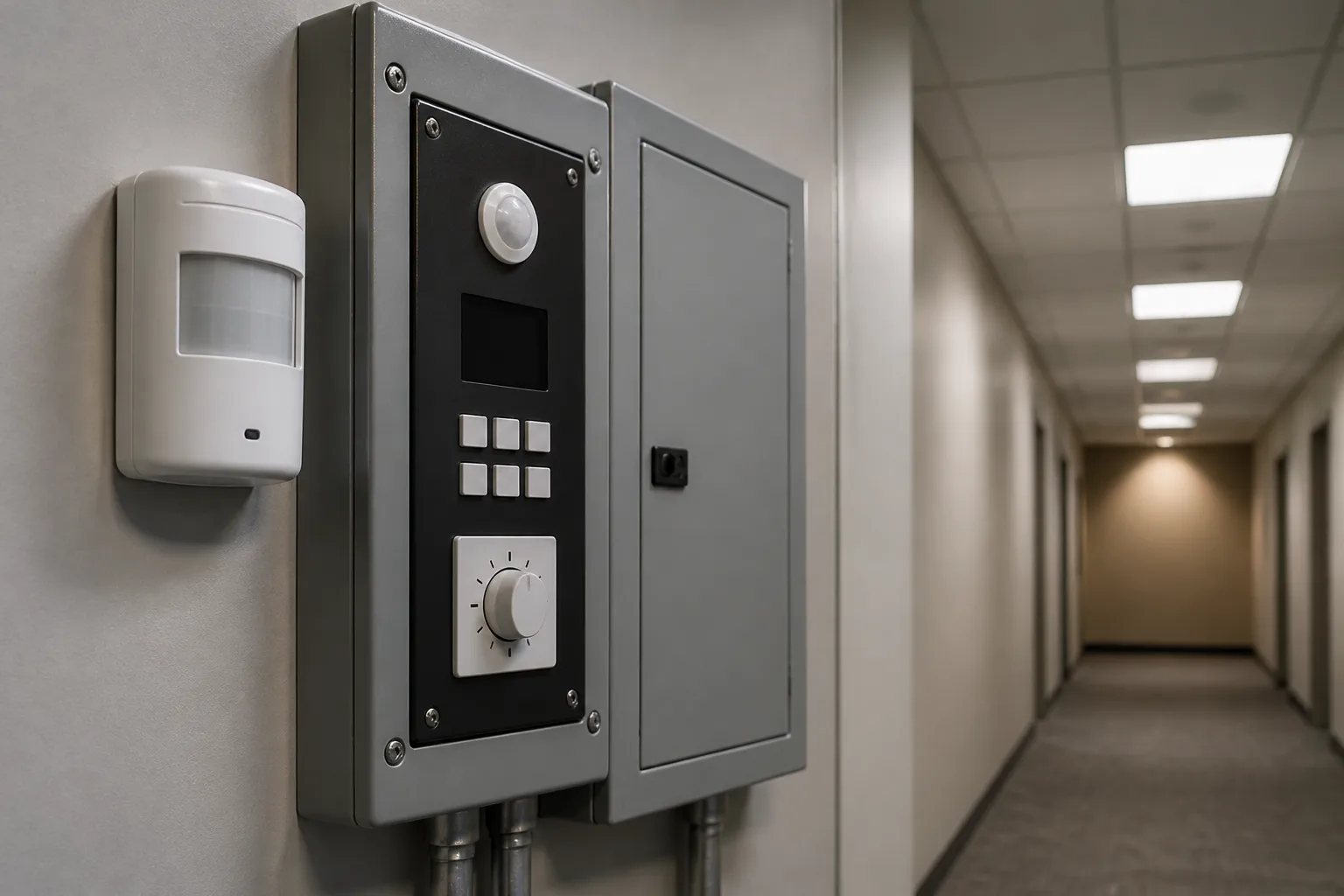
Keep the intended operation beside the fault report. For each affected zone, record when lighting should normally turn on and off, who is authorized to change settings, and what is happening instead. Review controls after changes to operating hours, occupancy, racking, partitions or tenant schedules. A control arrangement that once fit the space can become unsuitable after the way the space is used changes.
For exterior areas, observations may need to be made after dark. Record whether the concern is failure after dusk, operation in daylight, inconsistent behaviour between zones or an outdated schedule. Our lighting timers and scheduling service addresses the relationship between operating patterns, temporary overrides and later review.
5. Plan access before scheduling the work
Access can be the deciding factor in how a maintenance item is handled. A fixture above racking, machinery, parked vehicles or a garage ramp may require more preparation than a visible fixture at a low ceiling. Before requesting service, identify the approximate mounting height, space beneath the fixture, likely lift route, overhead obstructions, security requirements and the person who can release the area.

For a Gateway warehouse or industrial facility, dispatch movements, stock and active work areas can affect when an aisle is available. Include setup and restoration time in the work window, not only the time spent at the fixture. Compatible non-urgent deficiencies can sometimes be considered together when access requirements align. However, grouping work should not delay a significant operational problem simply to wait for a larger list.
High fixtures deserve their own access review because aisle width, floor condition, overhead services and fixed equipment can determine whether access equipment can reach the location. See our high-bay LED lighting information for related considerations around mounting, distribution and future maintenance access.
6. Use recurring issues to decide between repair and planning
Maintenance history is valuable because it distinguishes a one-off fault from a condition that keeps returning. Track repeat visits to the same position, recurring failures among a fixture family, unavailable parts, inconsistent replacements and the cost or disruption of repeated access. A record can also reveal when an old layout no longer supports the work beneath it.
A defined repair can still be the sensible choice when existing equipment remains suitable and the necessary parts and access are practical. A broader review may be more useful when replacement decisions have produced a patchwork of output, colour or control behaviour, or when high-access repairs are repeatedly interrupting operations.
Keep the immediate repair decision separate from any capital discussion. This lets the facility respond to today’s deficiency while comparing a staged improvement option on clear boundaries. Our commercial lighting upgrades service can help assess a troublesome equipment family, changed layout or control limitation without assuming that every older fixture must be replaced.
7. Close each work item with a usable handover
After service, update the record with the location, reported symptom, work completed, replacement information that changes the asset record and any unresolved condition. If another observation or visit is needed, identify the next action and who is responsible for it. This is particularly valuable when the building team, property manager, tenants and service provider each handle different parts of access and authorization.
For multi-tenant or managed properties, note which spaces were accessed and whether a temporary arrangement or changed control setting remains. Keep actual completed work distinct from recommendations that still need approval. A clear handover prevents a future report from restarting at the same vague description.
Service request checklist
Information to gather before requesting lighting maintenance
A short, complete record helps define the next step without asking site staff to diagnose electrical equipment.
- Property and exact affected area, using a location reference that others can recognize
- Observed symptom, including whether it is constant, intermittent, dim, damaged or schedule-related
- Number of affected fixtures and whether nearby fixtures or an entire zone behave the same way
- When the issue occurs and the lighting or control behaviour that is expected
- Photos from a safely accessible position and any available model or prior-service information
- Approximate mounting height, access restrictions, work window and site contact who can release the area
- Operational impact, such as an active route, loading activity, workstation or non-urgent storage area
When a site assessment is the next useful step
A site assessment is useful when the scope is unclear, several areas are affected, failures keep recurring or the issue may involve layout, controls and access rather than one obvious repair. Bring the property type, affected areas, known equipment details, photographs, operating hours, access restrictions and existing service records. Those details give the discussion a concrete starting point and help separate maintenance, repair and upgrade questions.
For Gateway facilities, a maintenance plan works best when it reflects the actual way each area operates. Keep records simple enough to update, make fault reports specific, include controls and access in the review, and use repeat history to support better decisions over time.
Helpful answers
Frequently Asked Questions
Put your lighting maintenance priorities into a clear site review
Share the affected areas, recurring issues, known equipment and access restrictions so we can begin with a practical scope.